FREE SAMPLE  ·  Full edition ₹99 ₹499  ·  Instant delivery
Free Sample · 2026 Edition

PromptingPedagogy

A to Z Prompt Engineering for Educators

1,138 classroom-ready AI prompts for planning, teaching, assessment, differentiation, feedback and everything else that eats a teacher's evening. This is a free preview of the complete second edition — including five prompts in full.

1,138 numbered prompts
50 sections across 5 parts
Every stage — foundational to senior secondary
Aligned to NEP 2020 & NCF-SE 2023
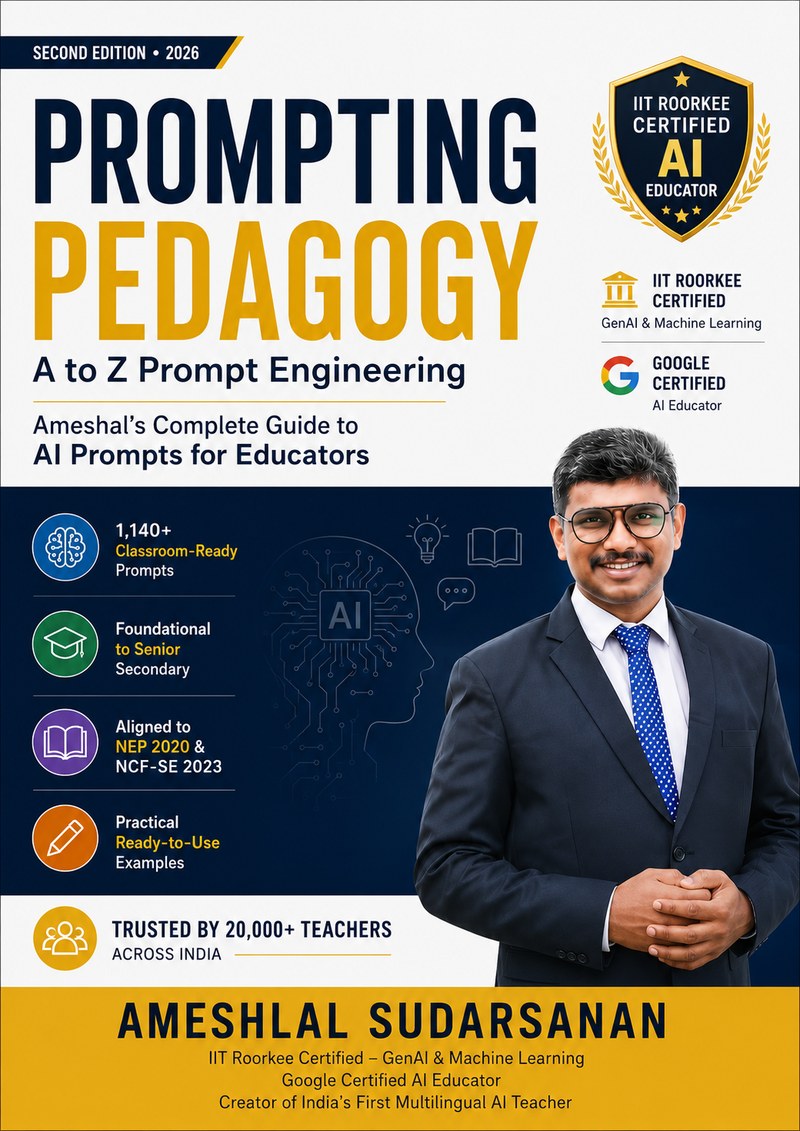
Prompting Pedagogy — Second Edition 2026 cover
The complete book

What's inside

Prompt numbers run continuously from 1 to 1,138, so a reference like “Prompt 604” always finds the same page.
Part One — Foundations
Chapter 1 — The 2026 AI Landscape for Teachers
Chapter 2 — The Anatomy of a Working Prompt
Chapter 3 — Fourteen Techniques Worth Naming
Chapter 4 — Reasoning Models, and When to Pay the Wait
Chapter 5 — Build It Once: Custom Assistants for Teachers
Chapter 6 — Multimodal and Agentic Classroom Workflows
Chapter 7 — Responsible AI: Privacy, Integrity, Bias and Policy
Chapter 8 — NEP 2020, NCF-SE 2023 and the Indian Classroom
Chapter 9 — The Thirty Foundational Prompts1–32
Part Two — Core Teaching Practice
Lesson Planning and Curriculum Design33–87
Explanations, Examples and Analogies88–122
Assessment Design and Rubrics123–171
Grading, Feedback and Answer-Sheet Analysis172–215
Differentiation and Inclusive Education216–259
Classroom Management and Behaviour260–299
Student Engagement and Motivation300–338
Questioning and Classroom Discussion339–368
Homework, Practice and Retrieval369–388
Remediation and Intervention389–408
Part Three — The Subject Library
English · Regional Languages · Mathematics409–542
Physics · Chemistry · Biology · Environmental Studies543–686
Social Science · Computer Science · AI, Data and Robotics687–822
Commerce · Arts, Music and Drama · Physical Education823–877
Part Four — Stage by Stage
Foundational (3–8) · Preparatory (3–5) · Middle (6–8)878–968
Secondary and Senior Secondary (9–12) · Higher Education969–1008
Part Five — Beyond the Classroom
Parent Communication · School Leadership and Administration1009–1058
Teacher Productivity · Professional Development · Co-Curricular1059–1123
Special Education, Counselling and Student Support1124–1138
Five of these prompts are reproduced in full below. The remaining 1,133, and all nine foundation chapters, are in the full edition.
Part One

What this sample doesn't include

The foundation chapters are the part teachers tell us changed how they use AI. They are in the full edition only.

The six-part prompt framework

Chapter 2 breaks a working prompt into six named components. Once you can see them, you can fix any prompt that isn't working — and write new ones without the book.

Fourteen techniques worth naming

The methods that separate a usable answer from a generic one, each with a classroom example.

Few-shotChain-of-thought Structured outputPrompt chaining Self-critiqueRubric-anchored Negative constraintsPersona-of-the-learner ContrastiveMultimodal Grounded / RAG+ 3 more

Reasoning models — when to pay the wait

Which tasks justify a slower, more expensive model, and which are wasted on one.

Build it once: custom assistants

The five assistants worth building this month, so you stop re-explaining your class every time.

Responsible AI in the classroom

Student data, academic integrity without the theatre, bias — and a school AI policy that fits on one page.

NEP 2020 & NCF-SE 2023

Where AI now sits officially, mapped to the 5+3+3+4 structure, plus multigrade and low-resource realities.

Also in the full edition: Chapter 1 on what these systems actually are and what each is genuinely good at · Chapter 6 on multimodal and agentic classroom workflows · The One-Page Card — the whole method on a single printable sheet for your staffroom wall.
Free sample

Five complete prompts

Reproduced exactly as they appear in the book — full text, expected outcomes, and the tip that makes each one work. Copy any of them and use it tonight.
Prompt 1 · The Core Four

The Instructional Coach — Lesson Planning Partner

PROMPT

You are a friendly and skilled instructional coach helping a teacher plan a lesson. Ask one question at a time and wait for my answer before moving on. Do not answer on my behalf. First, introduce yourself briefly and ask what topic I want to teach and the class and board I teach. Then ask whether students have prior knowledge of this topic, and if so, what I believe they already know and where they usually go wrong. Then ask what my learning goal is — what students should understand or be able to do by the end. Then ask how long the period is and what resources I actually have. Only after all of this, produce a customised lesson plan using a variety of techniques and modalities: a hook, direct instruction, a check for understanding that samples widely rather than asking “any doubts?”, a discussion, an engaging in-class activity, and an assignment. Explain in one line why you chose each element. Then ask whether I want to change anything, or whether I know of misconceptions students bring to this topic, and revise accordingly.

POSSIBLE OUTCOMES
  • A period-length plan matched to your actual constraints rather than an ideal classroom.
  • A rationale for each activity, which is what makes the plan defensible and adaptable.
  • A revision round that folds in the misconceptions only you know about.
TIPWhen it asks what students already know, resist the one-word answer. Three honest sentences here changes the entire plan.
Prompt 5 · The Everyday Twenty-Six

Differentiate This Lesson Three Ways

PROMPT

You are an expert in differentiated instruction. I teach [subject] to Class [X], [board]. Here is my lesson on [topic]: [paste plan or describe it]. My class of [number] includes students working well below grade level, students at level, and a few who finish early and disengage. Redesign this lesson into three tiers that run simultaneously in one room with one teacher. For each tier give me: the learning outcome (same core outcome, different depth), the task, the support or extension, and how I will know they got there. Then give me the exact set of instructions I say aloud so all three groups can start without me repeating myself. Constraints: [no printouts / one blackboard / 40 minutes].

POSSIBLE OUTCOMES
  • Three tiers sharing one core outcome, so the class stays together conceptually.
  • A single spoken instruction set — the thing that actually makes multi-level teaching survivable.
  • Checks for understanding calibrated to each tier.
TIPAsk for a fourth tier for students who are absent frequently and keep missing the thread. Most differentiation guidance forgets them.
Enjoying these? There are 1,133 more.
The complete second edition, plus three bonus resources — ₹99 today.
Get the full edition →
Prompt 6 · The Everyday Twenty-Six

Build an Assessment with a Marking Scheme

PROMPT

You are an assessment specialist. Design a [duration] assessment for Class [X] [subject], [board], on [topic]. The learning outcomes are: [paste outcomes verbatim]. Produce a blueprint table first — outcome, cognitive level, question type, marks — and let me approve it before you write questions. Then write the paper: [n] recall, [n] understanding, [n] application, [n] analysis or higher-order items. For every item, provide the answer, the marking scheme with mark-by-mark allocation, the common wrong answer, and what misconception that wrong answer reveals.

POSSIBLE OUTCOMES
  • A blueprint you can defend to an examiner or an inspection.
  • Diagnostic value: the wrong-answer column turns a test into a teaching plan.
  • Mark-by-mark schemes that make your marking consistent across a hundred scripts.
TIPInsist on the blueprint before the questions. Approving the blueprint first is what keeps the paper from over-testing the easiest outcome.
Prompt 10 · The Everyday Twenty-Six

Write Feedback That a Student Will Act On

PROMPT

You are a supportive but honest teacher giving written feedback. Here is a Class [X] student's work on [task]: [paste, with the name removed]. My rubric is: [paste]. Write feedback that: opens with one specific strength quoted from the work, identifies the two most important improvements — not every flaw — with the exact line each refers to, gives one concrete revision the student can make in ten minutes, and closes with a next step. Address the student directly as “you”. Keep it under 150 words. Do not mention a grade.

POSSIBLE OUTCOMES
  • Feedback limited to two actionable points, which is what students actually process.
  • Direct quotation from the work, so it cannot be mistaken for a template.
  • A ten-minute revision task that turns feedback into learning.
TIPGenerate feedback for five scripts at once and read them side by side. Repetition across scripts reveals what to teach the whole class rather than five individuals.
Prompt 13 · The Everyday Twenty-Six

Curate Resources for a Topic

PROMPT

You are a resource curator for Indian school teachers. I am teaching [topic] to Class [X], [board]. Suggest resources organised by type: free videos (with what specifically to watch and the exact minutes to use in class), readings at two difficulty levels, one hands-on activity using materials costing under fifty rupees, one simulation or interactive that works on a phone, and one real-world local example from India that connects to this topic. For each, say what it is good for and what its weakness is. Do not invent URLs — describe the resource precisely enough that I can search for it myself.

POSSIBLE OUTCOMES
  • Curated options with stated weaknesses rather than an undifferentiated list.
  • Timed video segments instead of “watch this 40-minute lecture”.
  • An Indian example that makes the topic local.
TIPThe instruction “do not invent URLs” is essential. Models fabricate plausible-looking links with unnerving consistency.
From the full book

How to use this book

Do not read it front to back. You will lose the will to teach somewhere around prompt four hundred.

Use it the way you use a spice rack. Part One is the technique you learn once. Parts Two through Five are the shelf you reach into on a Sunday evening when tomorrow's period has no plan.

The three-minute start

If you have never prompted an AI before, do exactly this and nothing else:

Open any AI assistant — ChatGPT, Gemini or Claude. The free version is enough.
Copy Prompt 1 above. Paste it. Press enter.
Answer the questions it asks you, honestly and briefly.
Keep talking to it for ten minutes. Argue with the output. Ask it to redo the weak part.

That is the entire skill. Everything else in the book is refinement.

The square brackets

Text inside square brackets — [topic], [grade], [board], [language] — is yours to replace before you send. A prompt that still says [topic] will get you a lesson plan about the concept of topics. Be generous when you fill them. [topic: photosynthesis] is fine. [topic: photosynthesis, specifically why the light and dark reactions confuse my Class 10 students who have already done respiration] is better, and costs you eleven seconds.

The one rule. AI drafts; you decide. Not a single prompt in this book is designed to replace your professional judgement — several are designed to interrogate it, which is a different and more useful thing. If an output feels wrong for your children, it is wrong for your children. You are not overruling a machine; you are doing your job.
About the author

Ameshlal Sudarsanan

Ameshlal Sudarsanan is an AI educator, curriculum designer and teacher-trainer working at the intersection of artificial intelligence and everyday classroom practice. He is IIT Roorkee certified in Generative AI and Machine Learning, and a Google Certified AI Educator.

His live and online AI-literacy sessions have reached over twenty thousand teachers, most of them in government and aided schools where the nearest thing to an ed-tech budget is a shared smartphone and a patchy data pack. That constraint shaped this book more than any research paper did. Every prompt here was written to work on a free tier, on a phone, in a classroom of fifty children, in a language the teacher actually thinks in.

He is the creator of India's first multilingual AI Teacher, a tool now used across schools in Kerala and covered by The Hindu and The New Indian Express. He leads AI literacy programmes under the SkillBharat initiative and continues to teach — because a book about classrooms written by someone who has left them is a book worth distrusting.

In 2024, most teachers asked “What is AI?” By 2026, the question has become “How do I use it without losing the part of teaching that matters?” This edition is an answer to the second question. Prompts are the steering wheel. This is a driving manual.
IIT Roorkee Certified — Generative AI & Machine Learning
Google Certified AI Educator
Creator of India's first multilingual AI Teacher
20,000+ teachers trained across India
Founder, SkillBharat AI & Future Skills Academy
Get the complete edition

1,138 prompts.
One evening back, every week.

You have just read five of them. Here is what the other 1,133 cost.
₹99
₹499
SPECIAL LAUNCH OFFER
All 1,138 numbered prompts, across 50 sections
Nine foundation chapters — the framework, the fourteen techniques, responsible AI
Every subject and every stage, foundational to senior secondary
Aligned to NEP 2020 and NCF-SE 2023
Bonus: AI Teacher Prompt Cheat Sheet · 30-Day AI Teacher Challenge · AI Safety Checklist
A personalised copy, licensed to you, delivered to your inbox in minutes
20,000+
teachers trained
across India
1,138
numbered prompts
in the full edition
IIT
Roorkee certified
GenAI & ML
2026
second edition,
fully rewritten
Every prompt in this book was written to work on a free tier, on a phone, in a classroom of fifty children, in a language the teacher actually thinks in. — Ameshlal Sudarsanan
GET YOUR PERSONALISED COPY — ₹99
Secure payment via Razorpay · UPI, cards and net banking · Instant digital delivery
Questions? ebooks@skillbharat.shop
Share this sample: ebook.skillbharat.shop/sample
Go further — certification programme

AI for Teachers — International Certification

The book gives you the prompts. The course teaches you the whole toolkit — image and video generation, text to audio, presentations and websites — in Malayalam, with a personal mentor on WhatsApp.
8 modules100+ AI tools
In MalayalamRecorded · lifetime access
WhatsApp mentorAsk doubts anytime
CertificateSkillBharat or UK Int'l
SEE THE COURSE →
From ₹799  ·  original ₹3,999
Full edition  ₹99 ₹499
1,138 prompts + 3 bonuses
Get it now →