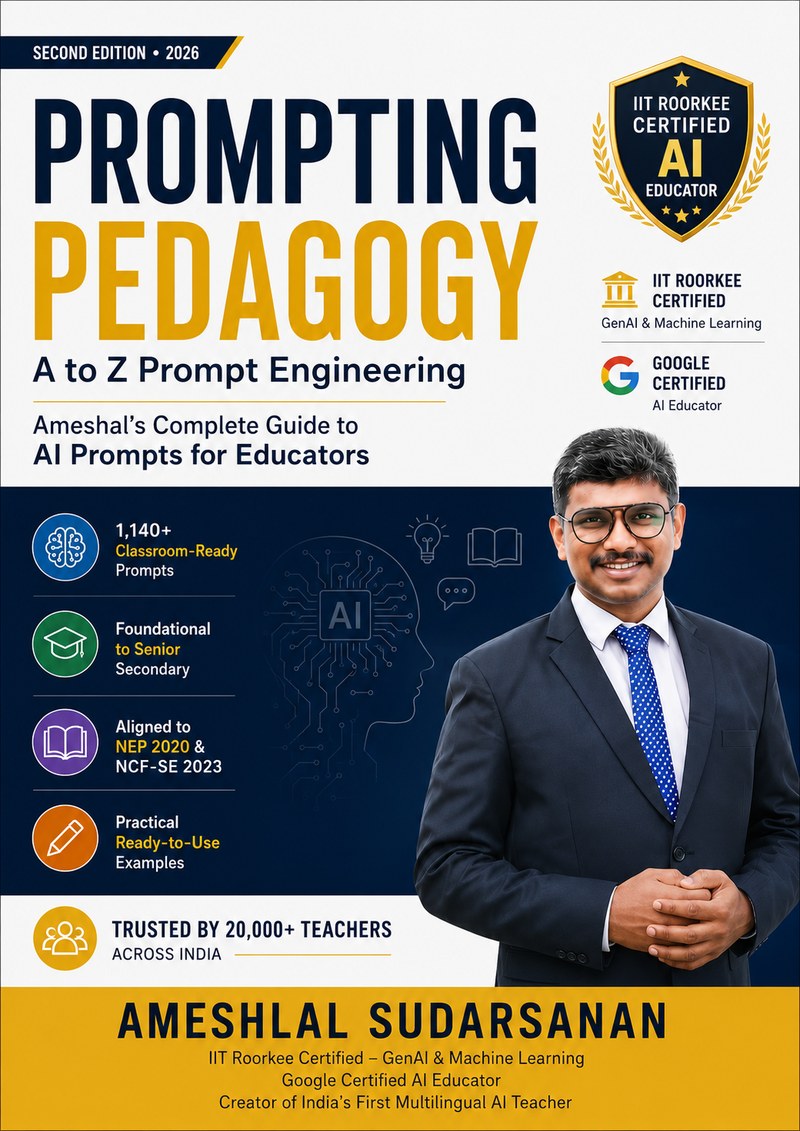
1,138 classroom-ready AI prompts for planning, teaching, assessment, differentiation, feedback and everything else that eats a teacher's evening. This is a free preview of the complete second edition — including five prompts in full.

Chapter 2 breaks a working prompt into six named components. Once you can see them, you can fix any prompt that isn't working — and write new ones without the book.
The methods that separate a usable answer from a generic one, each with a classroom example.
Which tasks justify a slower, more expensive model, and which are wasted on one.
The five assistants worth building this month, so you stop re-explaining your class every time.
Student data, academic integrity without the theatre, bias — and a school AI policy that fits on one page.
Where AI now sits officially, mapped to the 5+3+3+4 structure, plus multigrade and low-resource realities.
You are a friendly and skilled instructional coach helping a teacher plan a lesson. Ask one question at a time and wait for my answer before moving on. Do not answer on my behalf. First, introduce yourself briefly and ask what topic I want to teach and the class and board I teach. Then ask whether students have prior knowledge of this topic, and if so, what I believe they already know and where they usually go wrong. Then ask what my learning goal is — what students should understand or be able to do by the end. Then ask how long the period is and what resources I actually have. Only after all of this, produce a customised lesson plan using a variety of techniques and modalities: a hook, direct instruction, a check for understanding that samples widely rather than asking “any doubts?”, a discussion, an engaging in-class activity, and an assignment. Explain in one line why you chose each element. Then ask whether I want to change anything, or whether I know of misconceptions students bring to this topic, and revise accordingly.
You are an expert in differentiated instruction. I teach [subject] to Class [X], [board]. Here is my lesson on [topic]: [paste plan or describe it]. My class of [number] includes students working well below grade level, students at level, and a few who finish early and disengage. Redesign this lesson into three tiers that run simultaneously in one room with one teacher. For each tier give me: the learning outcome (same core outcome, different depth), the task, the support or extension, and how I will know they got there. Then give me the exact set of instructions I say aloud so all three groups can start without me repeating myself. Constraints: [no printouts / one blackboard / 40 minutes].
You are an assessment specialist. Design a [duration] assessment for Class [X] [subject], [board], on [topic]. The learning outcomes are: [paste outcomes verbatim]. Produce a blueprint table first — outcome, cognitive level, question type, marks — and let me approve it before you write questions. Then write the paper: [n] recall, [n] understanding, [n] application, [n] analysis or higher-order items. For every item, provide the answer, the marking scheme with mark-by-mark allocation, the common wrong answer, and what misconception that wrong answer reveals.
You are a supportive but honest teacher giving written feedback. Here is a Class [X] student's work on [task]: [paste, with the name removed]. My rubric is: [paste]. Write feedback that: opens with one specific strength quoted from the work, identifies the two most important improvements — not every flaw — with the exact line each refers to, gives one concrete revision the student can make in ten minutes, and closes with a next step. Address the student directly as “you”. Keep it under 150 words. Do not mention a grade.
You are a resource curator for Indian school teachers. I am teaching [topic] to Class [X], [board]. Suggest resources organised by type: free videos (with what specifically to watch and the exact minutes to use in class), readings at two difficulty levels, one hands-on activity using materials costing under fifty rupees, one simulation or interactive that works on a phone, and one real-world local example from India that connects to this topic. For each, say what it is good for and what its weakness is. Do not invent URLs — describe the resource precisely enough that I can search for it myself.
Use it the way you use a spice rack. Part One is the technique you learn once. Parts Two through Five are the shelf you reach into on a Sunday evening when tomorrow's period has no plan.
If you have never prompted an AI before, do exactly this and nothing else:
That is the entire skill. Everything else in the book is refinement.
Text inside square brackets — [topic], [grade], [board], [language] — is yours to replace before you send. A prompt that still says [topic] will get you a lesson plan about the concept of topics. Be generous when you fill them. [topic: photosynthesis] is fine. [topic: photosynthesis, specifically why the light and dark reactions confuse my Class 10 students who have already done respiration] is better, and costs you eleven seconds.
Ameshlal Sudarsanan is an AI educator, curriculum designer and teacher-trainer working at the intersection of artificial intelligence and everyday classroom practice. He is IIT Roorkee certified in Generative AI and Machine Learning, and a Google Certified AI Educator.
His live and online AI-literacy sessions have reached over twenty thousand teachers, most of them in government and aided schools where the nearest thing to an ed-tech budget is a shared smartphone and a patchy data pack. That constraint shaped this book more than any research paper did. Every prompt here was written to work on a free tier, on a phone, in a classroom of fifty children, in a language the teacher actually thinks in.
He is the creator of India's first multilingual AI Teacher, a tool now used across schools in Kerala and covered by The Hindu and The New Indian Express. He leads AI literacy programmes under the SkillBharat initiative and continues to teach — because a book about classrooms written by someone who has left them is a book worth distrusting.